Date: 24.04.2026 — 01.05.2026
Beginning: 19:00
Why deal with the decolonization of space research when nothing lives on the Moon, no one owns the regolith there, and lunar expeditions therefore have no one to threaten?
“It is coloniality, rather than curiosity, that lies at the heart of westernized conceptions of space exploration,” opens theorist Natalie B. Treviño her text Coloniality and the Cosmos. With this statement, she suggests that the modern discourse on space conquest is not a neutral exploration project, but rather follows the historical structures of power, expansion, and appropriation that have shaped colonial modernity. It draws attention to the more than five hundred-year-long tradition of discovery expeditions that pushed the “final frontiers” of European exploration and whose result, despite extensive scientific contributions, was the genocide of indigenous groups of both human and non-human populations, the extraction of natural resources, and the spread of the imperial ideology of the “white man”.
This ambivalence of a scientific mission is aptly illustrated by the example of James Cook’s voyage from 1768–1770, which is highlighted by anthropologist William Lempert, who in 2018 was part of the Indigenous research group within the American SETI (Search for Extraterrestrial Intelligence) program. The expedition of Cook’s ship HMS Endeavour, organized by the Royal Society in cooperation with the British Navy, was to officially observe the transit of Venus across the Sun in Tahiti, which would help to calculate the distance of the Earth from the Sun more accurately. However, Cook received unofficial instructions from the King of Great Britain to search for and possibly claim Terra Australis Incognita – the supposed “southern continent” – for Britain. Which is what happened in the end.
The ideology of discovery, accumulation of wealth, and raising flags is rooted both in the language of space colonies and in the very principles of exploration. An example is the vision of billionaire Jeff Bezos and his company Blue Origin, which plans to move heavy industry into space and build orbital colonies, which, according to his ideas, should relieve the mother planet struggling with the climate crisis. Such plans for the future coincide with the idea of cosmos as another space suitable for expansion, mining, and economic growth, which a sufficiently wealthy and technologically equipped person can dispose of as they please. Colonial cosmology did not end with the last “discovered” territory, but has persisted through industrial modernity into the present, where strategies of violence, ownership, and commodification are still reproduced. Along with them, there have been ideas about the future that reintroduce existing power structures and social order.
The famous sentence, often attributed to Slavoj Žižek and originally formulated by Frederic Jameson, that it is easier to imagine the end of the world than the end of capitalism, takes on multiplanetary dimensions with each new satellite or research robot launched. Do we face a future in which social injustice keeps most of humanity in miserable conditions, whether on Earth, the Moon, or Mars? Both Treviño and Lempert agree that a possible way to escape this endless loop of exploitation is to learn from peoples and societies that have survived and maintained their identity and culture even under conditions of colonial violence and oppression.
Although such visions are not yet making headlines, they represent a significant movement in contemporary art. One of the pioneering works of this approach, created during the Apollo missions and the American lunar landing, is the 1974 Afro-futuristic film Space Is the Place, directed by John Coney, whose concept was created by the poet, musician and visionary Sun Ra. In the film, Sun Ra, a jazz musician and philosopher “from outer space,” returns to Earth to show, through his music and cosmic vision, an alternative path to liberating the African-American community from oppression and segregation. In his presentation, the journey into space thus becomes a metaphor for the liberation of people and culture.
In her 2009 short film Space Exodus, Larissa Sansour continues this tradition by planting the Palestinian flag into the soil of the Moon, accompanied by an Arabic-like melody from Stanley Kubrick’s 2001: A Space Odyssey. A critically-aimed probe based on popularizing and romanticizing ideas of a human future in space creates a captivating image that reflects the ongoing violent uprooting of the Palestinian people and at the same time points out that space activities are not neutral imaginations, but a mirror of the historical and contemporary political ties of our society.
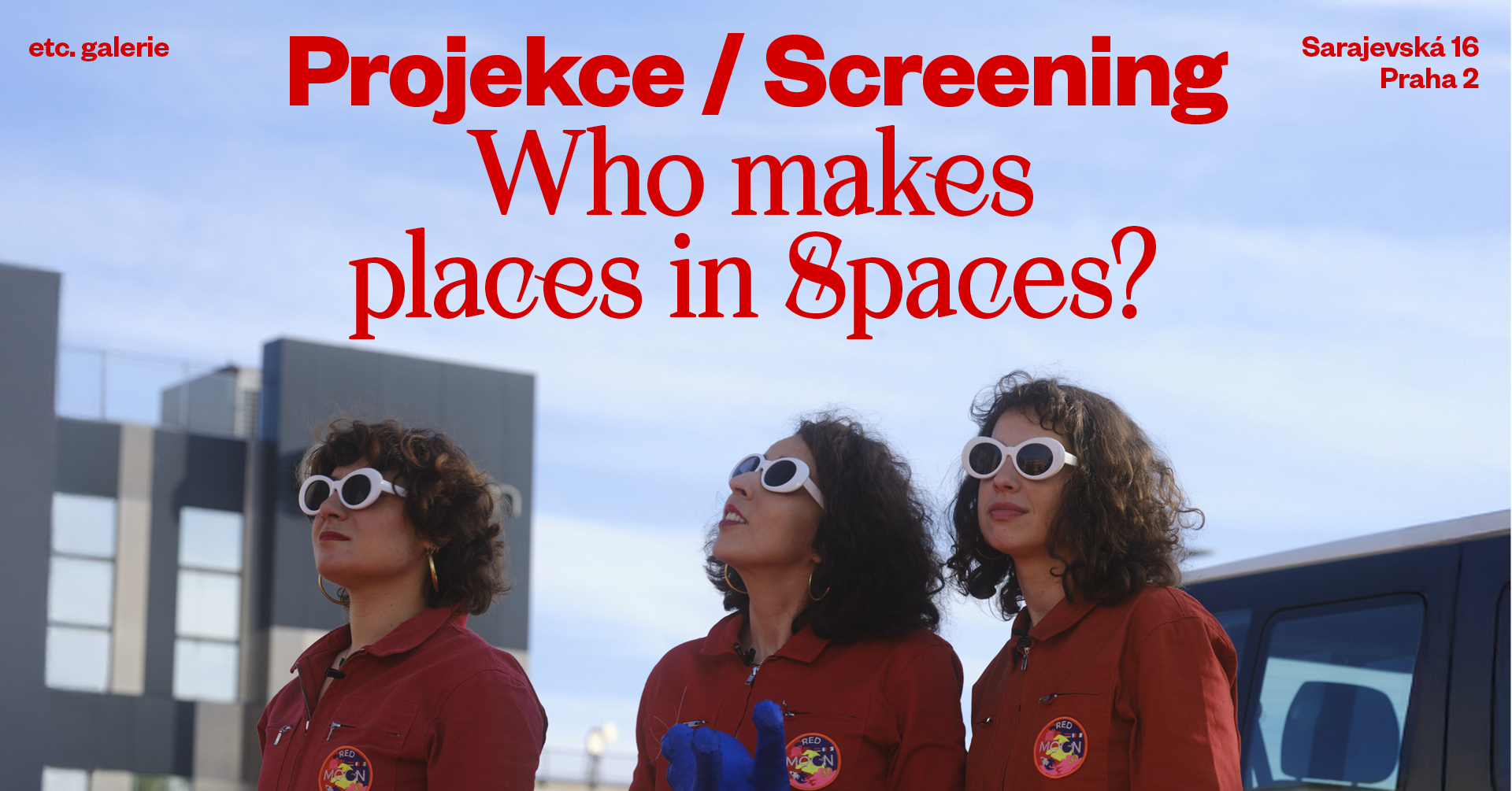
“A defining feature of liberalism is that your imagination has to be constrained. Think of the moon as the space where you can have unrestrained imagination. One example is, you can walk naked,” says one of the scholars interviewed in the film Doppelgängers³ (2024) by Dr. Nelly Ben Hayoun-Stépanian, director and founder of the Department of Experiences and Space Culture Department at the SETI Institute and NASA Ames Research Center. Together with her doppelgangers Myriam and Lucia, she explores diasporic, queer, and ecofeminist perspectives on colonizing the Moon. She draws on her own experience with the intergenerational trauma of the Algerian genocide and on interviews with experts across various fields, which she conducts together with her parallel selves before the mission. Together they search for the key to a civilization free from space commercialization and imperialism. Using experimental visual and sound layers, for which the author has approached Pussy Riot and Colin Self, for example, to collaborate, the film creates a space where traumatic experiences from the past can inspire ideas liberated from colonialist and commercial narratives about human life in space.
Sára Märc
Nelly Ben Hayoun-Stepanian: Doppelgängers³, 2024, 73′
Larissa Sansour: Space Exodus, 2009, 5′
Curator: Sára Märc
Production: Tereza Vinklárková, Nela Klajbanová
Graphics: Nela Klímová
Proofreading: Michal Jurza
Translation: Jan Ciosk
Photos: Lucie Sasínová
Thanks to: Academia Film Olomouc and translator Natálie Dutá
Made possible with financial support from: Magistrát hl. Města Prahy, MKČR